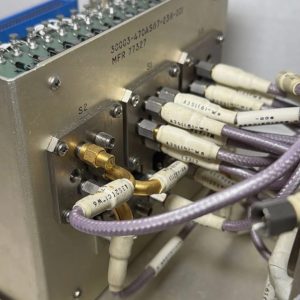
The Aviation Switching Module – NSN 4920-01-250-2696 (AS-IS / Untested) combines recognizable aviation hardware, an identifiable National Stock Number, potential electrical-control functionality, and commercial value for informed specialist buyers.
An Aircraft Switching Module may control, route, select, isolate, or distribute compatible electrical signals or circuits, while an Aerospace Switching Module should be evaluated according to its exact internal design and intended equipment relationship.
The Aircraft Electrical Switching Module may route selected circuits, while the Aviation Electrical Control Module, Aircraft Power Switching Module, Aerospace Electrical Control Unit, and Aircraft Signal Switching Module terms should not be interpreted as confirmed functions without documentation.
Accurate use of Aviation Control Module, Aircraft Electronic Switching System, Aerospace Switching Unit, and Aircraft Electrical Module terminology improves SEO without creating unsupported functional claims.
Understanding NSN 4920-01-250-2696
NSN 4920-01-250-2696 should be compared with the data plate, manufacturer number, contract markings, serial number, connector layout, and available documentation on the actual unit.
An identification plate should not be removed, repainted, altered, or covered because it may provide the strongest evidence of the component’s origin.
Evaluating Surplus Aircraft Electronics
The condition description should be understood as a limitation rather than a suggestion that the unit is probably operational.
A current-limited and controlled test setup may be appropriate when selected by qualified personnel.
Aviation Switching Hardware Uses
An Aircraft Switching Module may provide circuit selection, signal routing, controlled connection, isolation, mode selection, or interface functions within compatible aviation equipment.
External controls may include switches, selectors, indicators, circuit positions, covers, labels, or connection ports depending on the exact configuration.
Aerospace Switching Module Construction
Careful exterior evaluation can reveal evidence of previous use or damage before the unit is opened.
Protective caps should remain installed during storage and shipping when available.
Electrical Switching Module Condition
A burnt odor, melted material, soot, or arcing marks should be disclosed clearly.
Loose wires, nonstandard components, replaced relays, cut conductors, or evidence of field repair should be recorded.
Aviation Electrical Control Module Functions
The exact interface must be established through diagrams, manuals, connector data, or verified system information.
Careful preservation supports future study and accurate Aviation Electrical Control Module documentation.
Power Switching Module Inspection
Controlled bench evaluation should be completed by personnel familiar with aerospace electrical hardware.
Any successful limited test should be documented precisely without changing the overall status beyond what was actually verified.
Aviation Control Unit Inspection
The repair process should preserve original markings and configuration whenever practical.
Every repair should be photographed and recorded if the module is restored.
Choosing an Aircraft Signal Switching Module
An incorrect connection may damage sensitive electronics even when the module itself receives little power.
Original cable assemblies may add significant value when included.
Aviation Module System Integration
Associated wiring, power supplies, interfaces, switches, displays, sensors, test sets, or aircraft equipment may be required for meaningful operation.
A matching NSN or housing does not always confirm identical internal configuration when modifications or supersessions exist.
Restoring Aviation Switching Hardware
The unit can provide parts, reference information, display value, training opportunities, or a candidate for professional restoration.
Training use should avoid destructive modifications when the component has collectible or restoration value.
Power Distribution Module Inspection
Power distribution equipment may use switches, relays, terminals, bus structures, circuit protection, and control interfaces depending on design.
Mounting points should be inspected because secure installation can affect grounding, cooling, vibration resistance, and connector alignment.
Maintaining Legacy Aviation Control Equipment
Dust and surface dirt can often be removed carefully, but aggressive cleaning may damage labels, seals, finishes, or electrical parts.
Continuity measurements, insulation checks, contact-resistance testing, and component examination may be appropriate when performed by qualified personnel.
Aviation Power Control Module Uses
An Aviation Power Control Module can have specialized applications within aircraft systems, aerospace ground equipment, maintenance platforms, or test installations.
Safe handling is important even when the Aviation Power Control Module is sold strictly AS-IS.
Maintaining Aerospace Switching Equipment
A systems approach supports more accurate troubleshooting and restoration.
Intermittent switching problems can result from worn contacts, damaged connectors, corrosion, weak relays, cracked solder joints, unstable power, or harness faults.
Preserving Military Aviation Equipment
The unit should not be stacked beneath heavy equipment or left on conductive check here surfaces.
Insured and trackable transportation supports responsible sales of specialized aviation hardware.
Choosing an Aircraft Electrical Module
Commercial evaluation should focus on total project suitability rather than the purchase price alone.
The seller should explain whether the unit has been powered, opened, repaired, modified, tested, or removed from known equipment.
Untested Aviation Equipment Condition Checklist
A pre-purchase review should confirm the NSN, manufacturer, part number, serial number, markings, enclosure condition, connectors, switches, included accessories, storage history, modification status, and known application.
- Determine whether cables, plugs, manuals, test leads, mounting hardware, storage cases, or companion components are included.
- Inspect the enclosure for dents, cracks, corrosion, missing screws, altered holes, broken seals, damaged brackets, and signs of previous opening.
- Report shipping damage, missing accessories, identification differences, undisclosed repairs, or altered condition promptly.
Evaluating an Untested Electrical Module
A qualified technician may use controlled and current-limited equipment appropriate to the module design.
Test results should identify which circuits or functions were checked and which remain unknown.
Restoring the Aerospace Switching Module
Original labels, wiring routes, fasteners, finishes, and component locations should be preserved whenever practical.
The final product status should describe only the functions that were evaluated successfully.
Final Thoughts on the Untested Aircraft Switching Module
For the right purchaser, the unit can offer a useful foundation for technical research, controlled troubleshooting, component recovery, or legacy-equipment restoration.
An experienced aviation-electronics technician should assess the module before it is powered, installed, or connected to other equipment.
Whether the product is described as an Aircraft Switching Unit, Aerospace Power Distribution Module, Aircraft Electrical Control Unit, or Aviation Power Control Module, AS-IS limitations should remain clear.
With prompt attention to switches, connectors, wiring, enclosure condition, corrosion, labels, and internal components, the module can preserve its technical and commercial potential.